Otto
von Bismarck is born in 1815 in Mark Branderburg, Prussia. Bismarck has
acquired a degree in law from the University of Göttingen to become a civil
servant. From 1847 onwards Bismarck has been a member of the Prussian Diet and
Erfurt Parliament, served as a Prussian ambassador to the Germanic Diet, to
Russia and to France (Olson and Shadle, 1991, p.57). From 1862 onwards, Bismarck
works as a Minister-President and wages the three wars which unify Germany, and
becomes the first Chancellor of Germany. Bismarck’s stunning political success
with German plan is admired by many political figures. For instance, Kissinger
(March 31, 2011) calls Bismarck a “master statesman”. Scholars recognise
Bismarck’s political genius and analyse it in their works. For example, Pflanze
(1958, pp.492-493) notes that Bismarck is a statesman with an extraordinary
sense judgement and an ability to pursue their goal in the power politics of
the 19th century.
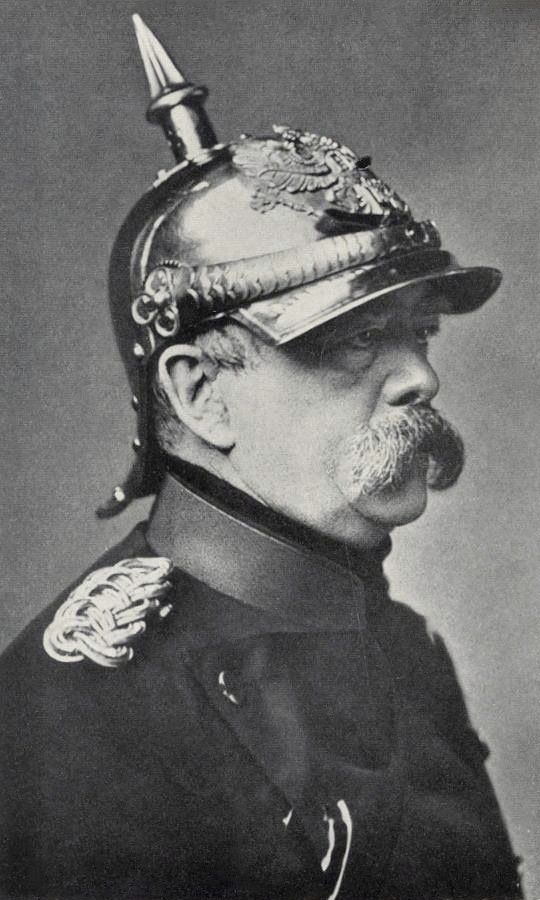 |
| By Uni Dusseldorf: Bismarck with Pickelhaube |
Bismarck is a popular subject in the academic research of the post-First World War period. Bismarck's contribution
to the process of German unification has been studied by historians and
publicists. However, scholars have not sufficiently explained Bismarck’s
approach to diplomacy. Notably, the issue which remains largely unaddressed is
the set of principles which Bismarck’s policy adheres to (Holborn, 1960, p.95).
This omission is crucial to understanding Bismarck, because their political
decisions have been noted to follow some rules which Bismarck has been devoted to
(ibid.). There are some scholars, such as Holborn (1960) and Pflanze (1958),
who attempt to sketch them, using the Bismarck’s early correspondence and memoirs.
However, the shallow theoretical base, which the contemporary researchers call Realpolitik, fails to explain Bismarck’s
framework of policy-making. Moreover, these studies fall short of explaining
how Bismarck has dealt with international politics, and managed to unify
Germany in three consecutive wars, which remains to be a riddle yet to resolve for
many historians (Kissinger, March 31, 2011).
In order to
avoid any confusion in respect of the substance of Realpolitik, a brief explanation is presented here. Bismarck’s
version of the Realpolitik tradition
belongs to the realist school, which includes contributions of Machiavelli
(Dietz, 1986), Waltz (Wayman and Diehl, 1994) and others. Nevertheless,
Bismarck’s understanding of Realpolitik is
scarcely reflected in Bismarck’s documents and letters. Consequently, Realpolitik is watered down to just
several ideas, which can be identified in Bismarck’s style of diplomacy.
The origins of
the mentioned approach lie in the work of Rochau (1853), called Grundsätze der Realpolitik. Nonetheless,
Rochau’s formulation of Realpolitik
is significantly different from Bismarck’s, and is mostly forgotten. For
instance, Holborn (1960, pp.94-95) notes the change in the meaning after the
1948. Realpolitik is identified as a
form of politics, devoid of ideological and moral principles (Oxford
Dictionaries, n.d.), and focusing on the pursuit of state interests, using the break-down
of the power structures (McLean and McMillan, 2009).
However, Bismarck’s
Realpolitik does not contain an
extensive set of principles because Bismarck soon acquires the prime-ministerial position and abandons the theory. Nonetheless, scholars use another
approach to learn more about Bismarck’s theoretical background. For instance, Stoler
(2005, p.7) points out that Bismarck is the most successful practitioner of
“the war as a continuation of policy” approach, developed by a Prussian scholar
Clausewitz. However, there is no extensive research to support this claim. This
is so, because the practical application of Clausewitz’s theory is exceedingly
understudied (Stoler, 2005, p.8), which in turn is due to the scarcity of cases
of politicians who practice it (Esposito, 1954). Thus, the test of Clausewitz’s
political theory on Bismarck’s policy-making may enrich the research on both
Bismarck and Clausewitz, and help to develop the policy-making, international
relations and strategy.
 |
| By Wilhelm Camphausen. Napoleon III and Bismarck talk after the Napoleon's capture at the battle of Sedan |
The reason why
Bismarck is noted to be a Clausewitzian is because they share a similar view of the
war and the policy-making. Clausewitz holds a high regard for one’s ability to
control the machinery of war and argues that a great policy-maker has to be
able to exercise restraint, and conduct a war only for the sake of securing a
political objective. To note, is it even possible to remain so focused on the objective,
and remain unaffected by the chaos and violence of war? Spence (2013, p.149) argues
that it is very difficult to concentrate on achieving political goal from the
moment of the war’s outbreak. However, Clausewitz points out that a reason and
impassionate judgement can turn a war into a policy instrument.
The kind of
control and the rationalist stance, which Clausewitz praises and Spence (2013) finds
extremely difficult to achieve, is frequently attributed to Bismarck, who
manages to reorganise Europe and unify Germany in just over a decade
(Kissinger, March 31, 2011). Bismarck is an example of a statesman who delivers
a political objectives and uses a war as the means. Therefore, this work serves
to fill the gap on Bismarck’s diplomacy by testing Clausewitz’s theory of
policy-making against Bismarck’s conduct of foreign policy. This study relies
on the discursive method to produce an in-depth analysis of the topic, densely
covered by historical material and various accounts (King et al., 1994, p.4).
This approach allows
to develop an impression of Bismarck’s set of principles and see whether
Bismarck’s policy-making is based on Clausewitz’s framework to any degree (Trachtenberg,
2006, pp.26-32). Also, Clausewitz’s theory holds an advantage compared to other
analytical tools in regards to Bismarck, because it maintains a high degree of
relevance to the historical context of Bismarck’s policy-making (Trachtenberg,
2006, p.45). The theory used in this analysis has been developed by a Prussian
who lives in the same political and historical conditions as Bismarck with only
a brief time gap.
Consequently,
this paper aims to investigate the proposition holding that Bismarck has
conducted a policy in accordance with Clausewitz’s approach. Moreover, it seeks
to do so by attempting to answer the question: how Clausewitzian is Bismarck? Such
a wording allows this study to explore the extent to which Bismarck is an
example of Clausewitz’s ideal policy-maker and gives the opportunity to reflect
on possible deviations from the model.
Furthermore, taking
into account that Clausewitz’s political theory is primarily focused on the
conduct of war, this study analyses Bismarck’s policy-making during the period
of wars for German unification. The wars of unification are the only wars which
are completely directed by Bismarck as a statesman. In order to ensure that the
sequencing of the events remains undisputed in the analysis, the wars are
discussed in a chronological manner (Kompf, 2010).
In addition, there
is only one type of the text source most readily available for this research-
the academic literature. Hence, this study uses a secondary literature, primarily
written in English language, such as the scholarly books, articles, and
translated official documents. This analysis may certainly omit some useful
academic works written in other languages, which could have sufficiently
enhanced one’s understanding of Clausewitz’s political theory. Nonetheless,
this study finds that the English-written literature is extensive enough to be
used for the research on Bismarck’s foreign policy-making.
The paper is
divided into three chapters. The first chapter examines Clausewitz’s political
framework and the scholarly literature on the subject. This is done in order to
explain the political concepts and Clausewitz’s political theory. The second
chapter briefly analyses Bismarck’s theory of Realpolitik, broken down into several political conceptualisations
and analysed based on its consistency with Clausewitz’s political theory. The
third chapter discusses the extent to which Bismarck’s foreign policy during the
period of German unification can be described as Clausewitzian. This chapter is
deals with Bismarck’s policy during the wars against Denmark, Austria, and
France.

No comments:
Post a Comment